



Course Overview
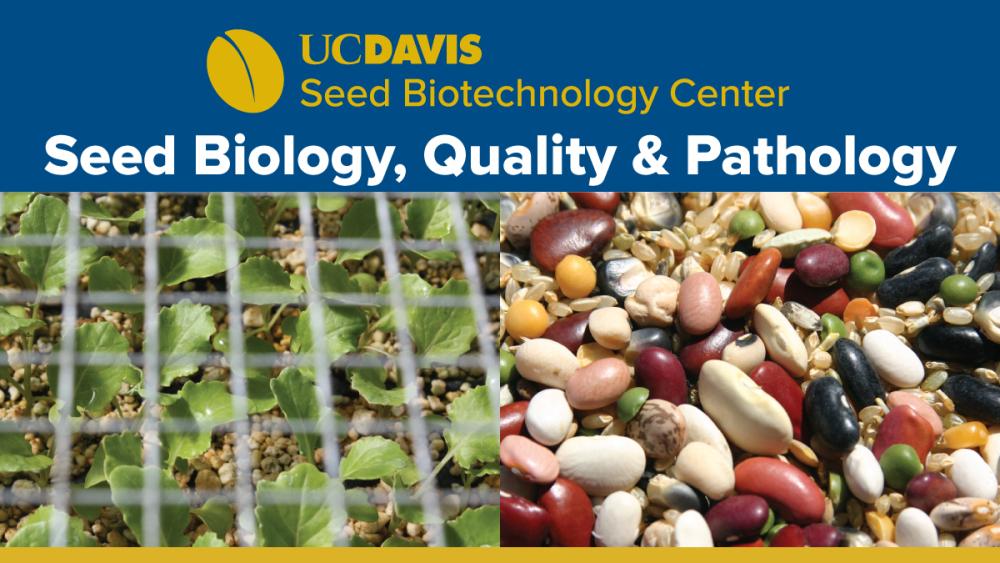
Delivering improved varieties through high-quality seeds is a vital component of modern agricultural production systems. It is critical that we understand the biological factors contributing to seed health, vigor, and viability, as well as how to measure these qualities. This course presents the scientific background and technical protocols for assessing, enhancing, and maintaining high seed quality. It also provides updates on new information, including seed pathology and enhancement. The course targets quality assurance professionals in the seed industry, new employees, consultants, breeders, and seed producers, helping them extend and update their knowledge. It's a very interactive course, with lots of hands-on exercises and demos.
Course Details
DATE TO BE ANNOUNCED (2028)
In-Person at UC Davis
Course is 3 days of in-person instruction
Times of class coming soon
Early Registration: $TBD
Regular Registration: $TBD
Tuition includes all course materials, lunches and breaks. Class size is limited so early registration is recommended.
Available Discounts:
25% off - Faculty (from regular registration)
50% off - Current Grad students/Postdocs (from regular registration)
Contact us for more information about your discount.
► Course Location:
Bowley Plant Science Teaching Facility:
1200 Extension Center Drive
Davis, CA 95616
► Hotel Recommendations:
Will update with information closer to the course date
► Campus Parking information (additional parking information will be emailed to participants before the course)
Course Curriculum
- Seed development and maturation
- Seed vigor and viability
- Seed health and phytosanitation
- Seed germination testing
- Seed pathology testing
- Seed genetic testing
Preliminary Lab topic areas:
- Standardized seed germination, vigor, and viability testing methods
- Seed purity testing methods
- Demonstration of new methods for seed quality and purity testing
- Standardized seed health testing methods
- Certification of labs for seed health testing
- Testing treated vs. non-treated seed (fungicide, bactericide, biological, organic & disinfectant treatments)
- Molecular vs. ‘biological’ seed health assays (indirect vs. direct assays)
- Location of infection of seeds by plant pathogens
- The sample size for seed health testing, seed sampling protocols
Instructors
Kent J. Bradford, Professor Emeritus, Department of Plant Sciences and former Director of the Seed Biotechnology Center, University of California, Davis, CA, USA. Kent received B.S. and M.S. degrees in Biochemistry and Horticulture from Michigan State University and received his Ph.D. in Plant Physiology from UC Davis in 1981. Kent was the founding Director of the Seed Biotechnology Center, interim Director of the World Food Center, and a professor in the Department of Plant Sciences at UC Davis prior to his retirement in 2019. Dr. Bradford’s research focused on the development, maintenance, and expression of seed quality, and he continues to contribute to the outreach, education, and research activities of the Center.
Samantha Thomas has earned an MS and Ph.D. in Plant Pathology from The Ohio State University. She has been with Monsanto for 11 years and currently, she is the Stewardship and Industry Affairs lead within Quality. She works across the seed industry and regulatory partners to develop and use quality tools to address the phytosanitary risk of seed movement. Her areas of expertise include seed pathology and seed health testing, seed movement, and best management practices for vegetable seed production.
Mike Pereira, Principal Consultant, Granum Services, LLC, has 42 years of experience in seed production, the majority of which was focused on vegetable seed production, but also more recent experience in biofuels and stevia seed production. Mike has extensive experience in leading global seed production organizations and establishing new production areas around the world. In biofuels, he established the first hybrid seed system for Miscanthus, an ethanol feedstock, and directed hybrid seed production and plantation research of Jatropha, a diesel and jet fuel feedstock. Currently, Mike consults in seeds and alternative crops through his company, Granum Services, LLC. He also is Chief Agronomist for Finistere Ventures, a leading venture capital company in agricultural technology, and is the lead instructor for three short courses for seed professionals through the Seed Biotechnology Center of UC Davis, Seed Business 101 – Horticulture, Seed Production, and Seed Biology, Quality and Pathology.
Kelley Clark, Director of Collaboration for Plant Pathogen Strain Identification (CPPSI). She obtained her PhD in Plant Pathology and Microbiology at UC Riverside studying citrus greening disease. From there, she completed a 3-year postdoc joint between USDA-ARS and the University of Arkansas researching spinach downy mildew in Salinas, CA. She brings experience in plant-pathogen interaction both at the molecular and applied level. She is looking forward to connecting the needs of industry professionals and others with the pathology resources that CPPSI provides.
Imtiyaz Khanday, Assistant Professor of Plant Reproductive Biology, Department of Plant Sciences and Director of Research for Seed Biotechnology Center. Imtiyaz obtained his Ph.D. in plant development and genetics from the Indian Institute of Science, Bangalore. Before joining Plant Sciences, he was a postdoc here in the Department of Plant Biology. As a postdoc, Imtiyaz translated the understanding of a mechanism of embryo initiation he uncovered in rice, into a method of clonal propagation through seeds or synthetic apomixis. His research interests include understanding seed development in cereals, the extension of clonal seed propagation to vegetable crops, and exploring ways to enhance seed vigor.
Riad Baalbaki, Senior Seed Botanist, Plant Pest Diagnostics Center, California Department of Food and Agriculture, Sacramento, CA, USA. Areas of specialization include seed viability and vigor determinations, as well as laboratory methods development for routine seed quality testing. His current research focuses on exploring the use of automated monitoring and data collection systems for identifying universal indicators of seed vigor, with emphasis on radicle growth measurements.”
Albre Brown, Associate Plant Pathologist, Plant Pest Diagnostics Center, California Department of Food and Agriculture, Sacramento, CA, USA. Areas of specialization include disease diagnostics, general plant pathology, integrated pest management, extension services, mycology, molecular biology, plant disease epidemiology, and phylogenetics. Current research focuses on identifying and characterizing ubiquitous plant pathogenic fungi limiting seedling germination and lifespan.
Geeta Sanjeev is the Global QC Director at HM Clause responsible globally for all HMC Labs. Accountable for developing and implementing business and operational strategy for the QC organization in line with the long-term strategy of HMC clause. Geeta joined HM Clause in 2008 as the seed health lab manager responsible for testing for seed borne diseases. In 2016 was promoted to QC director for Americas and in 2018 became the global QC Director. During her time in HMC, Geeta has contributed actively to development of seed health strategy and overseen the deployment of strong quality management systems across all labs. She was actively involved in international seed health initiative (ISHI) for vegetable seed crops, a forum for exchanging information, sharing expertise on seed health testing and facilitating the development of new seed health tests for economically important pathogens associated with seed. She served as chair for technical cucurbit group from 2012 to 2016 and was later the country rep for US at ISHI (2016 to 2018) besides being active in the vegetable technical committee of ASTA.
Matt May is a seed pathologist at Monsanto Vegetable Seeds in Woodland, CA. He has 35 years of experience in developing and conducting seed tests to detect fungal and bacterial seed transmitted and seed-borne plant pathogens.
Robert Gilbertson Distinguished Professor Robert L. Gilbertson has been a member of the faculty of the Department of Plant Pathology at UC Davis since 1990. He has established a research program in the areas of seed pathology, plant virology, and international agriculture, and has made numerous important contributions to these fields. He has received awards for his research including the Novartis Award for Outstanding Contributions to Agricultural Research, Fellow of the American Association for Advancement of Science (AAAS), Meritorious Service Award from the Bean Improvement Cooperative, The International IPM Excellence Award, the UC Davis Oscar Lorenz Award for meritorious service to the California vegetable industry and the AgSeeds Unlimted Award for dedication and outstanding service to the California processing tomato industry in 2019. Dr. Gilbertson and his colleagues have strived to integrate basic and applied research findings into sustainable integrated management of plant diseases caused by seed- and insect-transmitted pathogens. A major area of research has been the development, evaluation, and application of molecular tools to investigate seed-borne pathogens, including bacteria, fungi, and viruses. DNA fingerprinting and genomics approaches have been applied to investigate the diversity and populations of seed-borne pathogens. He teaches courses at UC Davis in Introduction to Plant Pathology, Plant Virus Vector Interactions, Plant Bacteriology, the Field Course: Diseases of Field, Fruit, Nut, and Vegetable Crops, and Feed the World, an undergraduate course. Throughout his career, he has been an active mentor of graduate students. His service activities have included being Editor-in-Chief of the international journal, Phytopathology, as well as serving as Editor for other journals.
Questions? Contact Louise Lee at [email protected].