



Research content below is updated as of the publishing of the SBC 2024-2025 Annual Report. View the full Annual Report here >>
GENETICS, GENOMICS AND BREEDING
CARROT
The Genetics of Bolting in Carrot
In 2023, SBC initiated work with Phil Simon (USDA/ARS, Madison, WI) on a second multiyear grant to characterize resistance to bolting and disease as well as quality and production traits over 4 years. Bolting has re-emerged as a priority with popularity of colored carrots and new germplasm. Leveraging results on studying bolting in 700 landraces by Theresa Hill (SBC), PhD candidate Deysi Alvaro Ceja meticulously tracked bolting to seed set in 1400 plants from 9 populations derived from landraces grown in 2 summer and 2 winter seasons. She also genotyped these to understand the trait. Clear differences in bolting were observed across environments, identifying loci controlling bolting and flowering. This program is funded by the USDA Specialty Crops Research Initiative.

Wild Carrots, a Source of Tolerance to Water Deficit and Alternaria

Also working with Phil Simon, the SBC is leading a grant to discover, introgress and genetically characterize tolerance to water deficit and resistance to Alternaria, both complex traits. Theresa Hill (SBC) and PhD student Terryn Hutchings are leading the project. We screened 350 wild carrot (Daucus carota) accessions in 2023, under well-watered and deficit irrigation in the field, focusing on several aboveground and below ground traits including bolting, top growth and yield, and capturing images of the sizes and shapes of carrot roots to create biparental and multi-parental breeding populations based on four top-performing landraces crossed to elite breeding lines and five other landraces. These populations were selected over two generations in 2024 and 2025 in the field under stress to create mapping and breeding populations that are being evaluated in 2026. Concurrently, the same set of 350 landraces were evaluated and advanced for resistance to Alternaria in Wisconsin by Simon. The 4-year project is funded by the Foundation for Food and Agricultural Research Crops of the Future program including Bayer Crop Sciences, Bejo BV, Enza Zaden, Rijk Zwaan BV, Takii and Vilmorin & Mikado Seeds. It is supplemented by the Kent J. Bradford Endowment.
CELERY
Multiple Genomes are Needed to Understand Resistance to Fusarium
The SBC (Van Deynze, Hill) is working with Lynn Epstein, Chaehee Lee, Grey Monroe (UC Davis), and Peter Henry and Renée Eriksen (USDA/ARS, Salinas) to sequence the genomes of a founding variety (Challenger) that has resistance to Fusarium race 2 and a UC Davis breeding line resistant to race 4. The high-quality Challenger genome has been published in Plant Journal, identifying a number of structural variants relative to other genomes published. A genome of equivalent quality is close to publication that has allowed identification of several race-specific candidate resistance genes based on in-depth annotation and differential gene expression analysis among accessions while challenged with Fusarium races. Sequencing was done at the UC Davis Genome Center. This work is funded by Bejo BV, BASF Vegetable Seeds and the California Celery Board.
FINGER MILLET and SORGHUM
The SBC (Van Deynze and Hill) is collaborating with Eduardo Blumwald (UC Davis) to adapt his groundbreaking technology to use gene editing to confer nitrogen fixation in finger millet and sorghum, two critical crops for African nutritional security. By knocking out genes, the flavone apigenin accumulates and is secreted by roots to attract nitrogen-fixing bacteria to the root zone. They in turn form biofilms around themselves to lower the local oxygen environment that is required for the enzyme that converts nitrogen gas from the air to ammonium, a form that that can be readily used by the plant for growth. This groundbreaking technology not only may have dramatic economic impact, but it can also make healthy foods available to populations that need it the most. It may have significant environmental impact by reducing nitrous oxides, the most potent greenhouse gases that directly degrade the ozone and affect climate change. This project is further training AfPBA graduates as visiting scientists Emily Gichuhi (Kenyan Agricultural and Livestock Research Organization, Kenya) and Yemisrach (Yemi) Melkie (Bio and Emerging Technology Institute, BETin, Ethiopia). Hiromi Tajima, Theresa Hill and Juan Debernardi support the project. It is funded by the Grantham Foundation.
PEPPER
Designing a Pepper for Mechanical Harvesting
In 2024-25, we continued to work on mechanical harvesting of pepper in collaboration with Stephanie Walker (New Mexico State University). With a good understanding of the inheritance of destemming and determinacy in pepper, we are now focusing on plant architecture needed for the mechanical harvest system based on a stripper (double helix) type harvester by Etgar Ltd. With this system, fruit are stripped from plants that remain in the ground, which requires a dominant tap root, stems with no basal branching and fruit set at least 6 inches above the ground. This is the natural architecture for seeded peppers practiced in New Mexico, but not that of transplanted hybrid peppers in California. We have been able to modify plant structure simply by using Q-plugs as media and transplanting at 4 weeks rather than 6 weeks after seeding. This eliminates the rootball and results in improved root and shoot structure in most genotypes, allowing for objective selection of desired plants from transplanted peppers. We are defining inheritance for these traits while selecting in several backcross populations that also contain the destemming trait in the field. The project is conducted by Theresa Hill (SBC), Francesca Ortega and Israel Joukhadar (NMSU), each leading publications on this topic (Hill et al 2023, Ortega et al. 2024 and Jokhadar et al 2024). A third USDA/NIFA grant supporting this project was obtained beginning in 2023. In 2025, we are pursuing mechanical harvesting in bell peppers with harvester companies, Etgar Ltd. and
Guaresi International, and local growers.
Resistance to a Resistance-Breaking Strain of Tomato Spotted Wilt Virus in Pepper
In 2018-2019, resistance-breaking TSWV strains (RB-TSWV) to the Tsw gene were identified in Yolo, Merced and Fresno counties by Robert Gilbertson (UC Davis). These strains are now also in coastal areas accounting for as much as 15% of TSWV strains in California. In collaboration with Robert Gilbertson, we have identified a stable source of resistance that we have introgressed into bell and jalapeno types. Although inheritance is complex, robust phenotypic and diagnostic assays were developed for greenhouse inoculations. Advanced lines performed well in 2023/2024 in fields verified to have the RB-TSWV strains. We are in the process of finishing bell pepper lines for seed increase. Allen Van Deynze, Armando Garcia-Llanos, Theresa Hill, Maria Rojas and Robert Gilbertson are leading the project. Funding is from the USDA/NIFA, the CDFA Specialty Crops Block grant and private sources.
Breeding for Heat Stress and Water Deficit in Pepper
In 2024 and 2025, we evaluated and genetically mapped two BC2S2 populations derived from landraces and an elite jalapeno line. Physiological, fruit quality and yield traits using empirical and surrogate traits with hyperspectral and RGB imaging to develop vegetative indices were measured to capture fruit quality under water and heat-stressed and optimal conditions. Although most traits showed variation across treatments and genotypes, the majority only have low correlations with yield. Pollen viability and two vegetative indices showed the highest correlations to yield under stress. Despite having common recurrent parents, genomic selection
models were only effective when all data were combined, allowing for prediction in an additional population. We advanced and tested six BC3/BC4 populations for their stability and fruit quality in well-watered and water-stressed environments in the field. The top performing and predicted lines are being evaluated in 2026 with the goal of releasing improved germplasm. Theresa Hill (SBC) and Gen-Ha Park (PhD candidate) managed the project.

In Fall 2024, we partnered with The Ohio State University to extend this research to bell peppers. Connor Soderstrom, PhD candidate, is co-leading the project. In 2025, 15 commercial hybrids and breeding lines were evaluated for the above traits in Davis and another 11 hybrids at OSU under water-stressed and optimal conditions. All the tested commercial lines showed significant reductions in yield under water stress, confirming the need to breed for water and heat stress. OSU also evaluated 92 recombinant inbred lines derived from landraces to genetically map traits. At UC Davis, 30 landrace-derived BC1 populations were advanced in the field. Funding was from the Specialty Crops Multi-state Program and the Department of Plant Sciences.
Gene Editing in Pepper
Agrobacterium transformation in pepper is very inefficient and limited to a single genotype in pepper. The SBC has been working for the last 7 years on testing alternative technologies to gene edit pepper. Based on publications we pursued nanobead and carbon nanotube-based technologies in collaboration with Markita Landry (UC Berkeley). Sirisupa (Trent) Sripolcharoen (PhD graduate) elegantly dissected specific growth stages for pollen, axillary buds and embryos to optimize delivery of CRISPR/Cas9 for gene editing. Expression of Cas9 was verified in all 3 tissues. Unfortunately, gene edits were not detected in several hundred plants. Due to the importance of this technology, alternative strategies are being pursued including collaborations with Alfred Huo (Univ. of Florida) who published promising results to gene edit pepper using growth regulators to promote shoot proliferation. We are also working with Savithramma Dinesh-Kumar (UC Davis) on virus-induced gene editing.
SPINACH
Breeding Baby Leaf Spinach for Resistance to Downy Mildew, Cadmium Uptake and Nitrogen Use Efficiency
Allen Van Deynze is co-leading a breeding program with Charlie Brummer (Director, UC Davis Plant Breeding Center) focusing on developing broad genetic resistance to downy mildew (DM) in baby leaf spinach to complement major gene resistances and possibly delay their breakdown. Oon-Ha Shin (PhD) manages the daily activities of the program with support from Steve Klostermann, (USDA/ARS) in Salinas. In 2024-2025, conventional field trials were conducted in Salinas and Davis to evaluate disease resistance, leaf quality and yield in over 40 segregating and advanced populations that were screened in the growth chamber as well. After 3 cycles of selection, we show marked improvement of resistance to downy mildew for current races in the Salinas Valley. Top selections that do not carry known resistance gene loci based on DNA makers show signs of reduced and delayed infection by the current races of DM found in the coastal valley. Populations are being advanced and tested in community trials led by Jim Correll (Univ. of Arkansas) in the Yuma and Salinas valleys.
Danyelle Forte, PhD student, (UCD) evaluated and genotyped 160 families for uptake of cadmium (Cd) in an effort to map loci and develop genomic selection models associated with cadmium accumulation in the field and hydroponic systems in spinach. Sheriff Seedy-Phaal (MSc) showed that although growing spinach with 22 hrs light did accelerate flowering time marginally, the time from flowering to seed set can be dramatically reduced (up to 3 weeks) under these conditions in some genotypes, laying the foundation for a strategy to rapid cycle spinach lines for breeding.
Oon-Ha Shin tested 42 populations derived from landraces for nitrogen use efficiency. He developed strategies using a combination of remote sensing, vegetative indices and genomic selection to improve prediction models from 0.2 to 0.75 accuracy. Genetic markers for dry weight, total N and nitrates in spinach were developed. Importantly, breeding populations that can grow well under low nitrogen are being developed. This program is funded by the California Leafy Greens Board with support by USDA/ARS, Specialty Crops Research Initiative.
SEED SCIENCE, SEED PRODUCTION AND BIOLOGY
Improving Seed Vigor for Better Crop Establishment
Seed vigor is a critical determinant of crop uniformity and establishment. It influences how quickly and uniformly seeds germinate, establish seedlings and tolerate stress conditions. Under field conditions, seeds often encounter fluctuating temperatures, variable and often limited soil moisture, and other environmental stresses, which are becoming more pronounced as climatic conditions become increasingly variable. Thus, improving seed vigor is becoming increasingly important for crop establishment and a priority for both agriculture and the seed industry. Supported by the USDA, the Foundation for Food & Agriculture Research (FFAR), and the Western Regional Seed Physiology Research Group (WRSPRG), our research aims to uncover the developmental, physiological, and molecular mechanisms that regulate seedquality acquisition, with the long-term goal of improving seed performance across diverse environments.
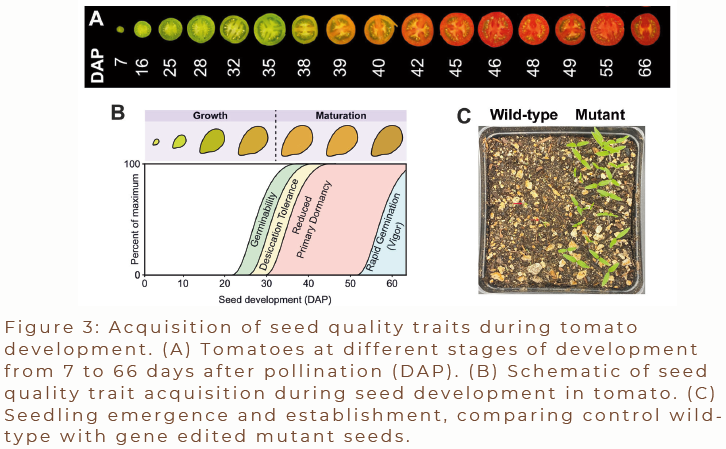
Using tomato as a model system, we combine developmental biology, genomics, gene editing, and seed physiology to identify the genetic pathways that control seed quality. Our work has defined the developmental progression through which seeds acquire desiccation tolerance and germinability, shed dormancy, and progressively develop vigor during maturation. We identified a previously unrecognized late-developmental window in which seed vigor continues to increase beyond physiological maturity. We also uncovered key molecular regulators associated with these transitions. Using gene editing to modify genes involved in abscisic acid
biosynthesis, we have developed tomato seeds with enhanced vigor that germinate faster and more uniformly and establish successful seedlings under environmental stress. The knowledge gained from this work could provide broadly applicable strategies for improving seed quality and crop establishment across diverse crop species.
Deciphering Cell Fate Specification During Rice Embroygenesis
The earliest stages of plant embryogenesis establish the developmental blueprint from which all tissues and organs arise. While considerable progress has been made in understanding embryo development in the model plant Arabidopsis, the molecular mechanisms governing early embryogenesis in cereal crops remain poorly understood. Our research aims to uncover how cell fate is specified during rice embryogenesis and to identify the gene regulatory networks that direct the formation of distinct embryonic tissues.

To address these questions, our laboratory combines genetics, inducible gene expression systems, transcriptomics, and advanced imaging approaches. We use embryo defective mutants to dissect the earliest developmental events following fertilization and identify genes responsible for tissue differentiation and embryonic pattern formation. Understanding these fundamental developmental processes will not only advance basic plant biology but also provide new opportunities to improve regeneration and reproductive engineering in cereals.
Engineering Synthetic Apomixis for Clonal Hybrid Seed Production
Hybrid crops provide substantial improvements in yield, resilience, and quality through heterosis or hybrid vigor; however, these advantages are lost in subsequent generations due to genetic segregation. As a result, hybrid seed must be recreated each season through controlled crosses. This process often requires labor-intensive procedures, including manual emasculation, male-sterility systems, and controlled pollen transfer, all of which substantially increase hybrid seed production costs. Our research has demonstrated the feasibility of synthetic apomixis, or asexual clonal seed formation, a technology that enables hybrid plants to reproduce clonally through seed while preserving hybrid vigor. We previously reported the first successful engineering of synthetic apomixis in rice by combining clonal gamete formation with parthenogenesis, thereby establishing a strategy for fixing heterosis in cereal crops.
Our current research focuses on extending this breakthrough to dicot crops, particularly solanaceous species. Supported by the Innovative Genomics Institute (IGI), Berkeley and the UC Early Career Faculty Research Excellence Award, this project first seeks to understand the reproductive biology of solanaceous crops, which differs substantially from that of cereals. Our initial efforts are focused on developing synthetic apomixis in potato. Potato is one of the world’s most important food crops and it is currently propagated primarily through seed tubers, which are costly to produce and transport and are vulnerable to disease transmission. We are developing synthetic apomixis in potato to enable clonal propagation through true potato seed, with the goal of combining the advantages of hybrid breeding with the efficiency, lower cost, and disease-free nature of botanical seed. Successful development of this technology could transform potato breeding and seed systems while providing a framework for engineering clonal seed propagation in other economically important dicot crops.